About the Project
Traditional teaching practice evaluation relies on direct human observation, an approach that is expensive, logistically complex, and inherently subjective. MoviSound addresses this gap by processing synchronous classroom recordings through a multimodal AI pipeline and delivering structured, explainable feedback to teachers through a web interface.
The platform runs as a set of decoupled Docker services. A Django frontend handles users, uploads and reports, while a separate FastAPI backend does the heavy lifting: transcription with Whisper, speaker diarization, paralinguistic feature extraction, and fine-tuned language models (BERT) interpreted through SHAP-based explainability frameworks. Neither side touches the other's database, which lets the backend serve other university projects that never use this frontend. The goal is not just classification accuracy, but transparency: teachers need to understand why the system draws the conclusions it does.
This platform is the applied result of my doctoral thesis, awarded Summa Cum Laude by the University of Murcia in 2026.
System Architecture
Each node in the diagram is an independent Docker container. Users reach the Django frontend through Caddy, which keeps accounts, recordings and reports in SQLite. When a recording is uploaded, Celery hands it to a frontend worker that copies it into MongoDB, the shared layer between both halves of the system, and triggers a backend run. The FastAPI backend transcribes the audio, extracts the acoustic features and applies the models developed during the thesis, publishing every step to Kafka so the frontend consumer can update the interface while processing is still running. A local Ollama instance turns the transcript into a summary of the session and a set of general guidelines. Final results go back to MongoDB, and the frontend consumer writes them into SQLite for the teacher to browse.
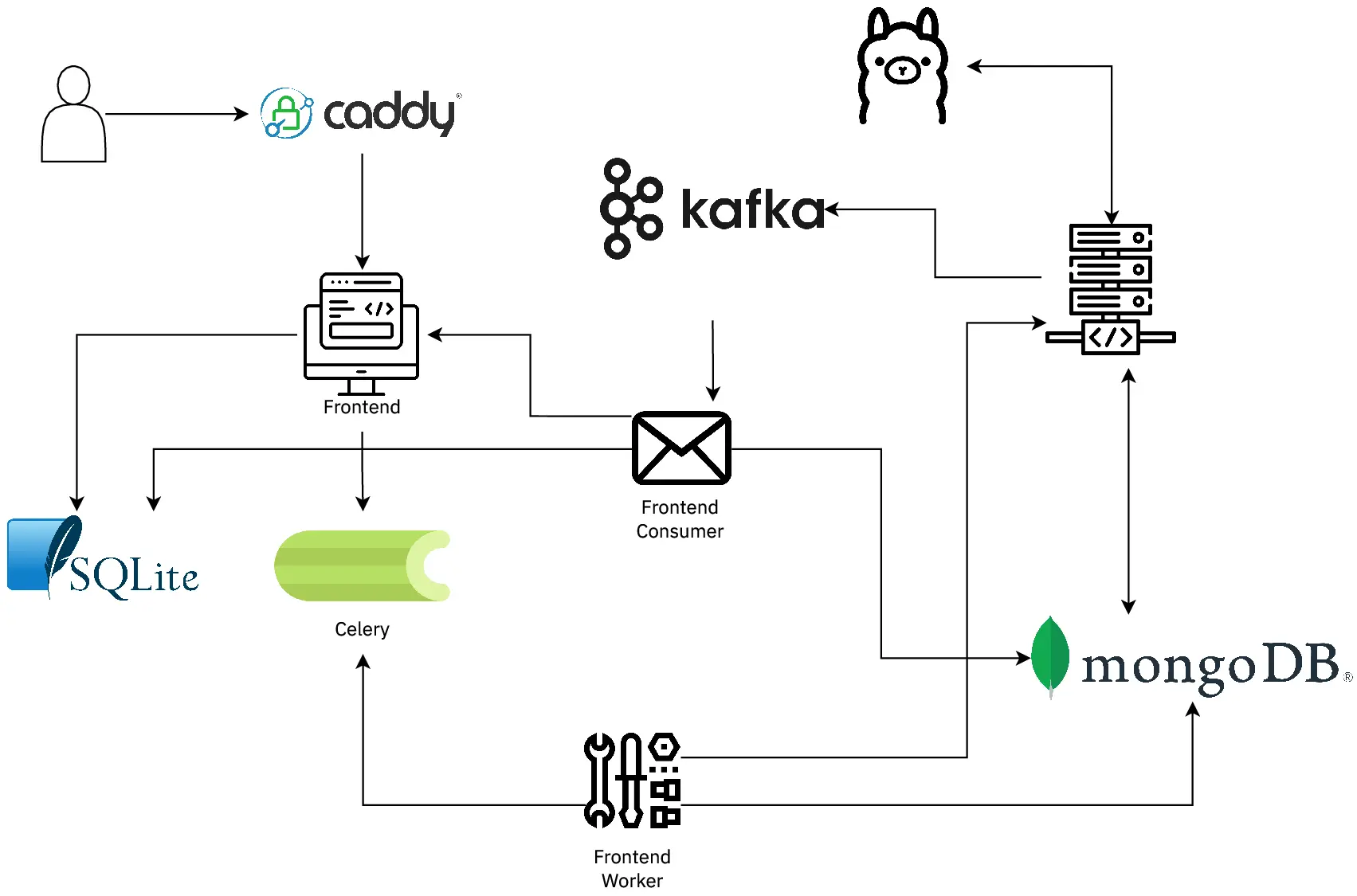
MoviSound microservices architecture
Platform Demo
The walkthrough below covers the platform in two parts. First a tour of the architecture, service by service, and then the web interface itself: uploading a real classroom recording, watching the pipeline report its progress in real time, and going through the results, from participation metrics and the teaching methodology timeline to the diarized transcript and the summary generated by the language model.
Research Publications
The platform was developed across three peer-reviewed papers published in JCR-indexed journals, each covering an incremental phase of the methodology.